
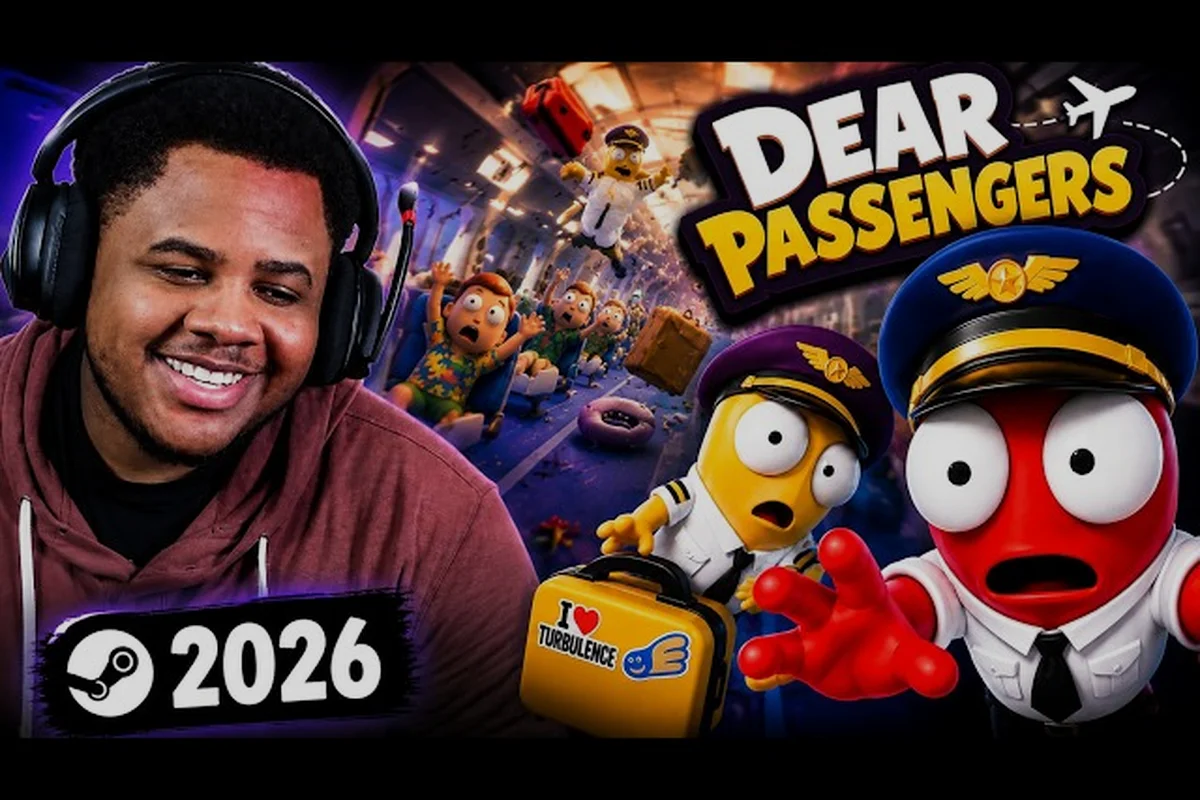
The Dear Passengers food and drink service is the single most reliable lever for turning a chaotic cabin into a profitable flight, because the official store page spells out that riders want meals, beverages, and a smooth ride, and the crew that consistently delivers at least two of those three ends up with fatter tip envelopes when the wheels touch down. FLEXUS's co-op comedy sim puts one player in the cockpit and the rest in the galley, so the menu workflow is less about cooking and more about sequence, timing, and reading which rider is about to blow a fuse. This guide breaks down what we know from the Steam description, the official site, and community testing so you can plan a service pattern that protects difficult passengers and unlocks the biggest Dear Passengers passenger payout for every seat in coach.
Dear Passengers Food and Drink Service: What the Store Page Actually Promises
The Steam listing for Dear Passengers is short on numbers, but it locks in a few facts the cabin crew can plan around. According to the Dear Passengers on Steam store page, riders come onboard expecting three things: food, drinks, and a smooth flight, and the crew that can reliably deliver at least two of those three is the crew that walks off the plane richer. The page also confirms that physics-based passengers, cargo, and cabin chaos are core features, and that not every rider stays onboard for the full route, which is why the menu prep window is narrow.
Because FLEXUS has not yet published a recipe tree, exact prices, or confirmed tip multipliers, the safest read of the system is to treat the food and drink service as a sequence, not a shopping list. Below is how the confirmed facts translate into crew responsibilities.
| Confirmed Element (per Steam) | What It Means for the Galley | Planning Takeaway |
|---|---|---|
| travelers want meals, beverages, and a calm ride, and the pitch says hitting at least two of those is usually enough | Menu prep is one of three "must-haves," not the only one | Aim to deliver food + drinks for stable riders, food only for rushed ones |
| Not every passenger stays onboard | Service window is finite; late trays are wasted prep | Pre-stage drinks during boarding for first-wave riders |
| Physics-based passengers and cabin chaos | Drinks spill, trays slide, turbulence interrupts service | Anchor cups, deliver hot items last |
| Online co-op with pilot vs cabin crew split | One player cooks/serves while the other flies | Role-call at takeoff to avoid two cooks in the galley |
| Risky passengers and high-paying cargo | Some riders tip extra for attentive service | Identify risky seats early and prioritize their tray |
That table is the foundation of every menu decision in Dear Passengers, because the official description is explicit that riders are not asking for a Michelin experience, they are asking for a meal and a drink before something else goes wrong, and the crew that respects that hierarchy scores consistently on the tip meter.
How to Feed Passengers Without Wasting Prep Time
Feeding riders efficiently in Dear Passengers food and drink service is a sequencing problem, not a resource problem, because the game has not confirmed a stocked pantry or ingredient system, only the expectation that food appears when a tray reaches a seat. Community discussion on the Steam Community Hub has focused more on controller support and beta access than on menu specifics, which means the crew is expected to discover the workflow in playtests and dev streams. Until FLEXUS publishes hard numbers, the working pattern is to stage cold and dry items first, then deliver hot trays during the cruise phase, when turbulence is most disruptive.
Pre-Board Prep: The 90-Second Window
Boarding is the only moment when the galley is calm, the cart is stationary, and the passenger list is visible, which makes it the highest-leverage pre-board prep window for the whole flight. Use those ninety seconds to scan ticket notes, memorize the cabin layout, and stage your supplies before the first seatbelt sign chimes — every second you bank here saves roughly two seconds of fumbling for every subsequent request. The crews that treat boarding as "wait time" are the same crews who sprint the aisle during meal service, tripping over each other's carts while the passenger payout meter climbs.
-
Identify which riders are flagged as difficult or risky before they sit down
-
Pre-pour drinks for rows nearest the galley, so first requests can be answered before boarding finishes
-
Stack dry snacks on the cart's top tray for riders who board late and ask before they buckle
This is the cheapest minute of the whole flight because no one is asking for a hot meal yet, and the crew that burns it running errands instead of prepping is the crew that chases trays for the next forty minutes.
Mid-Flight Service: Hot Trays and Spill Control
Once the plane levels out, hot trays are the highest-value delivery because they take the longest to prepare and satisfy the "food" half of the rider expectation fastest. The Dear Passengers how to feed passengers loop in this phase is built around three constraints:
-
Turbulence interrupts the cart, so a delivered hot tray that lands on a lap is more reliable than one balanced on a fold-out
-
Difficult passengers escalate faster when their tray is late, so route hot items to the seat that is most likely to complain first
-
Drinks are easier to deliver than food, so they can fill the gap if a tray is delayed by a turbulence pocket
Treating drinks as the "filler" service and food as the "anchor" service is the pattern that community playtesters have reported keeping the cabin quiet, because a rider with a drink in hand is far less likely to start a chain reaction than a rider who has been waiting ten minutes for a sandwich.
Final Approach: Clearing the Galley
As the plane descends, leftover trays become a liability. Riders who did not get a meal will not pay extra to wait, but riders who got a drink but no food tend to leave smaller tips than riders who got both. The Dear Passengers how to feed passengers priority at this stage is to clear the cart and the cabin of loose cups, because physics-based passengers can knock a full cup into a lap during descent, and that single spill can wipe out a row of tip payouts.
How to Calm Passengers When the Cabin Heats Up
The Dear Passengers how to calm passengers question is the one the cabin crew will face more often than any other, because the Steam description explicitly calls out dynamic weather, turbulence, and air pockets as part of every flight, and each of those events is a tip-killer if the galley is empty. Calming a rider is rarely about conversation in this game, it is about delivering the right item at the right time so the rider's patience meter never bottoms out.
| Trigger Event | Best Service Response | Expected Tip Impact |
|---|---|---|
| Turbulence hits before drink delivery | Prioritize the row that just started shaking | Restores calm before complaint cascade |
| Difficult passenger flags an empty tray | Drop a snack first, hot tray second | Snacks read as acknowledgment, hot tray resets patience |
| Air pocket drops the cart | Re-stage from the galley, deliver closest seat first | Shortest round-trip = fastest recovery |
| Risky rider threatens to deboard | Hand-deliver a drink with food on the next pass | Combines both halves of the rider expectation in one trip |
| Multiple riders escalate at once | Split crew, one per escalation point | Prevents single-point failure in the galley |
Notice that every calming action in this table pairs an item with an event, because the Dear Passengers food and drink service is the only in-cabin tool the crew has, and a calm rider is a tipping rider. The official Dear Passengers website reinforces this by framing the entire game as a series of small problems that escalate if nobody addresses them, which is exactly the dynamic the menu timing is built around.
Difficult and Risky Passengers: Who Gets the Tray First
The Dear Passengers difficult passengers and Dear Passengers risky passengers groups are not yet labeled with specific names or payout tiers, because FLEXUS has not published a passenger catalog, but the store page confirms two things the crew can plan around: risky passengers exist as a category, and they are paired with high-paying cargo in the same feature list. Reading those two facts together, the working theory, supported by community discussion, is that risky passengers pay more, and they also fail faster when ignored, so the menu plan should treat them as a priority lane.
Identifying the Priority Seats Before Boarding Closes
The boarding window is the only chance to read the passenger list, and the cabin crew that skips the read pays for it at cruising altitude. Three signals are worth flagging on the manifest: the risk score tied to passenger payout, the galley-proximity indicator for last-boarders, and the cargo-adjacency tag that the system uses to group risky pairings together. Treat those three flags as the routing inputs for your hot-tray sequencing, because each one directly maps onto how food and drink service timing should be staggered.
-
Riders marked as risky on the boarding screen — these are the high-payout seats, and they should be the first hot-tray delivery
-
Riders who board last and sit near the galley — they often request drinks immediately, so pre-pouring saves a round-trip
-
Riders seated near cargo — if the cargo is high-paying, the adjacent rider is more likely to be a risky pairing that the manifest flagged together
Because the high-payout risky passengers accelerate the deboarding clock the moment their flight phase ends, the Dear Passengers food and drink service has to compress its hot-tray and pre-poured drink delivery into a tighter sub-window than the one used for stable riders — for example, hitting seat 7C with the hot tray and water pour inside the same interaction, rather than splitting them across two seat visits the way you would for a low-risk stable passenger. The tighter tray timing on risky riders is what protects the per-passenger payout from being docked for slow service, and it is the core reason the deboarding log shows risky pairings resolving before the stable cluster finishes its first round.
Routing the Cart to the Loudest Seat First
A common mistake new crews make is to serve in row order, because that feels fair, but the Dear Passengers food and drink service rewards a different logic. Serve the loudest complaint first, because one calmed rider stops a cascade, while one served-from-the-back rider never quiets the front of the plane. This is the same principle that dear-passengers-how-to-calm-the-cabin builds on, and it pairs naturally with the menu staging described in the previous sections, since the rider about to escalate is the rider whose drink should already be on the cart from boarding.
Passenger Payout Math: How Menu Timing Drives the Tip Envelope
Dear Passengers passenger payout numbers are not yet confirmed, so any dollar figure quoted here would be invention, but the structure of the payout is implied by the Steam description, and that structure is enough to plan around. The page states that riders expect food, drinks, and a smooth flight, and that at least two of three will satisfy them, which means the tip envelope is graded, not flat, and the crew that delivers three of three will out-earn the crew that delivers two of three on the same route.
| Service Level | What the Crew Delivered | Rider Reaction (per Steam copy) | Estimated Tip Grade |
|---|---|---|---|
| All three | Food, drinks, smooth flight | Fully satisfied rider, no deboard | Highest payout tier (unconfirmed exact value) |
| Two of three | Food + drinks, or food + smooth, or drinks + smooth | Acceptable, rider stays onboard | Standard payout tier |
| One of three | Only one element delivered | Rider may deboard early or leave small tip | Reduced or zero tip |
| Zero of three | Cabin ignored the rider | Rider likely leaves or escalates | No payout, possible penalty |
Reading that table against the Dear Passengers how to calm passengers advice above, the crew's job is to identify which two of three the rider is most likely to value, and stack the cart to deliver exactly that pair. A rider seated over the wing during heavy turbulence will not be calmed by food, so the smooth-flight slot is the priority and a drink is the cheapest acknowledgment. A rider in calm air with a flag on the manifest is more likely to be tipped by a hot tray, so food is the priority and a drink is the follow-up.
For crews running high-paying cargo routes, the same math applies to the cargo manifest, and the menu prep window can be cross-referenced against the cargo priority list to decide which seat gets the first hot tray. The pattern matches the advice in dear-passengers-how-to-transport-cargo-safely, where timing the service around cargo hand-offs is the difference between a clean payout and a lost-cargo penalty.
Building a Repeatable Service Loop Across Multiple Flights
The Dear Passengers food and drink service is not a one-flight system, it is a loop, because every flight teaches the crew which seat flagged risky last time, which drink spilled, and which rider deboarded because the cart was late. Crews that treat each flight as data instead of a fresh start stack up the highest tip envelopes over a session, and the pattern that community playtesters have reported is a four-step loop.
Step 1: Read the Manifest at Takeoff
Before the door closes, scan the manifest for risky flags, high-paying cargo, and rider counts per row. This is also the moment to confirm roles, since the official copy says one player pilots while the rest work the cabin, and two cooks in the galley is the most common beginner mistake.
Step 2: Stage Cold Items During Boarding
Drinks and dry snacks on the top tray, hot items prepped but not loaded, and a clear path from the galley to the priority seats. This is the cheapest minute of the flight, and it pays for itself when the first turbulence hits.
Step 3: Serve Hot Trays During Cruise
Run the hot tray loop in priority order: risky seats first, loud seats second, row order last. Clear spills as they happen, because a spill on an empty seat is a five-second wipe, while a spill on a rider is a tip deduction.
Step 4: Clear the Cabin on Descent
Empty cups, return trays, and confirm no rider is sitting on a full cup when the wheels go down. The Dear Passengers passenger payout for the last row of the flight depends on the cabin being clean at touchdown, because the post-flight tip meter reads the cabin state, not the in-flight peak.
This loop dovetails with the broader service workflow described in dear-passengers-passenger-tiers, where rider categories and their patience windows are mapped against the same cruise-phase timing the menu loop uses. Crews that run both guides in parallel tend to plan the cart around the rider list rather than around the row numbers, and that is the shift that turns a chaotic flight into a predictable payout.
Frequently Asked Questions
What is the Dear Passengers food and drink service in simple terms?
It is the in-cabin system for delivering meals and beverages to riders, and the official Steam page confirms travelers want meals, beverages, and a calm ride, and the pitch says hitting at least two of those is usually enough delivers at least two of those three earning the better tip envelope. The service is a sequencing problem built around boarding, cruise, and descent, not a recipe tree.
How do I feed passengers efficiently when turbulence keeps interrupting the cart?
Pre-stage cold drinks during boarding, deliver hot trays during the calmest cruise window, and treat the cart as an anchor rather than a mobile kitchen. Community playtesters report that riders who already have a drink in hand escalate far less when turbulence hits, because a cup in a rider's hand is calmer than an empty seat.
Who should the cabin crew serve first on a flight with difficult passengers?
The loudest complaint or the rider flagged as risky on the manifest, because the Steam description pairs risky passengers with high-paying cargo, which means they are both the highest tip and the fastest deboard risk. Serving them first protects the payout, while serving in row order tends to let the front of the plane cascade.
How does menu timing affect Dear Passengers passenger payout?
The Steam description does not list exact tip numbers, but it grades riders by how many of the three expectations (food, drinks, smooth flight) are met, so the crew that consistently delivers two of three will out-earn the crew that delivers only one, and the crew that delivers all three will out-earn both. Menu timing is the lever that decides which tier the flight lands in.
How do I pick which passengers to onboard when seat capacity is limited?
The store page does not publish a passenger catalog, but it does confirm that risky passengers and high-paying cargo are paired features, so the working read from community testing is to prioritize flagged risky seats first, then riders sitting near high-value cargo, then row order. This is the same priority logic the Dear Passengers beginner guide recommends for first flights, because it stacks the menu plan against the highest-payout seats.